
Minnesota Mutual Aid Directory
Don't stop being Minnesota nice. Get Minnesota Mad.
Minnesota Mutual Aid Directory
Don't stop being Minnesota nice. Get Minnesota Mad.
Protesting
Protesting
Protesting is a collective tool for public pressure. It is how people make harm visible, challenge abuses of power, and demand change when existing systems fail to respond. Protests take many forms and involve different levels of visibility and risk. Over time, effective collective action depends on practice, coordination, and shared experience. This page is a practical guide to understanding protest strategies, participation options, and the realities of engaging in collective action, not a set of instructions or recommendations.
Finding Events
Mobilize.us
A widely used national platform that lists protests, rallies, trainings, and volunteer opportunities organized by advocacy groups and coalitions across the U.S.
https://www.mobilize.us/
Women’s March MN – Calendar of Events
A well-maintained calendar of local events.
https://www.womensmarchmn.com/google-calendar
MNMAD Community Bulletin Board
This site’s community bulletin board has local actions shared by community members, including events that may not appear on national platforms.
Local Advocacy & Political Action Groups
Many protests are announced directly by local advocacy organizations and grassroots networks through their own websites, mailing lists, or social media. Examples in Minnesota include Indivisible Twin Cities, MN 50501, and TakeAction Minnesota.
MN ICE Out Events
A community maintained Google Sheet of events.
View here.
Community Resource Listings
The site’s community resource directory includes additional local organizations, mutual aid groups, and advocacy efforts that may share or organize actions related to their work.
Not all protests are publicly listed. Some actions are shared through trusted or private networks to manage risk, capacity, or participant safety. Local neighborhood groups and community organizations are often key sources of this information.
Know Your Rights
This section provides general information about rights related to protest and public assembly in Minnesota. It is not legal advice.
Constitutional foundations
In Minnesota, as in the rest of the U.S., people have the right to peacefully assemble, protest, and express their views under the First Amendment to the U.S. Constitution and similar protections in the Minnesota Constitution. Peaceful expression such as standing on sidewalks, carrying signs, and chanting is protected in public spaces.
Where protests are allowed
Public spaces such as sidewalks, parks, and other government-owned areas open to the public are generally lawful places for protests. Cities like Minneapolis and St. Paul explicitly recognize these rights in local guidance.
Permits and time/place/manner rules
Local authorities can require permits for assemblies that block streets, disrupt traffic, or otherwise affect public safety, but they cannot deny permits based on the content of the protest. Restrictions must be content-neutral and aimed at public safety, not speech suppression.
Lawful vs. unlawful conduct
Protected protest does not include illegal behavior such as blocking freeways without authorization, trespassing on private property without consent, damaging property, or throwing objects. Individuals engaging in such acts may face arrest or charges under Minnesota law.
Unlawful assembly and crowd charges
Minnesota law criminalizes “unlawful assembly” and “riot” when groups intentionally disturb the peace or use force or threats of force. Penalties range from misdemeanors to more serious charges depending on conduct and outcomes.
Police power and public safety
Police and public safety officials may issue orders to disperse if there is unlawful activity, threats to public safety, or statutes are being violated. Local guidance warns that failing to comply with lawful orders from officers may lead to arrest even if you did not engage in illegal activity yourself.
Rights and enforcement can vary by city, county, and situation, and new court decisions and local policies can affect how rights are applied in practice.
For more detailed information about protester rights under U.S. law, see the ACLU’s Know Your Rights guide for protesters:
https://www.aclu.org/know-your-rights/protesters-rights
Strategies
Protests use different strategies to apply pressure, shift public attention, and limit harm. Each strategy serves a distinct purpose and carries different levels of visibility and risk. Understanding how these approaches work helps people recognize the many ways collective action can take shape.
Civil Disobedience
Intentional, nonviolent violation of laws or rules, such as sit-ins, occupations, or blockades, to expose injustice and force moral or political confrontation. This strategy is planned, disciplined, and undertaken with clear awareness of legal risk.
Example: Sit-ins at segregated lunch counters during the U.S. civil rights movement, where participants knowingly broke local laws to challenge racial segregation.
Cultural & Narrative Intervention
Shaping public understanding through storytelling, art, symbolism, media engagement, and framing to change how an issue is perceived and discussed. This strategy works by redefining what feels normal, acceptable, or urgent.
Example: ACT UP’s use of bold visuals, slogans, and media-savvy actions to reframe the AIDS crisis as a political failure rather than a personal tragedy.
Disruption
Interrupting normal operations, such as traffic flow, institutional routines, or supply chains, to make harm impossible to ignore and force response. Disruption creates urgency when visibility or messaging alone is insufficient.
Example: The 2016 Standing Rock protests, where water protectors disrupted construction of the Dakota Access Pipeline by physically blocking work sites and access roads.
Economic Pressure
Using financial leverage like boycotts, strikes, divestment, or withdrawal of labor or consumption to impose material or reputational costs on decision-makers. This strategy targets profit, stability, reputation, and long-term viability.
Example: The Montgomery Bus Boycott, which applied sustained economic pressure to challenge segregation in public transportation.
Institutional Pressure
Leveraging formal systems such as courts, regulations, oversight processes, public comment, and documentation to slow, block, or expose harmful actions. This strategy is often quiet, procedural, and cumulative.
Example: Civil rights organizations using lawsuits and court challenges to dismantle segregationist policies in the U.S. during the mid-20th century.
Mass Demonstration
Large-scale public gatherings such as marches, rallies, and vigils that make the size and legitimacy of public opposition visible. This strategy builds momentum, coalition strength, and social normalization of dissent.
Example: The Women’s Marches in 2017, which demonstrated widespread opposition and helped catalyze local organizing across the U.S.
Mutual Aid & Community Care
Providing direct support such as food, medical care, housing assistance, or childcare, while building trust and resilience within communities. This strategy sustains participation and reduces reliance on systems that are failing or causing harm.
Example: The Black Panther Party’s Free Breakfast for Children Program, which met immediate needs while building community power and political consciousness.
Protective Presence & De-escalation
Reducing harm and preventing escalation through trained support roles such as marshals, medics, legal observers, and documentation teams. This strategy protects participants and preserves accountability during actions.
Example: During the 2020 Black Lives Matter protests, National Lawyers Guild legal observers were present at demonstrations to monitor police conduct and document arrests and use of force.
Solidarity Actions
Cross-movement support that expands pressure and prevents isolation. Solidarity demonstrates shared stakes and raises the cost of repression.
Example: Labor unions supporting the U.S. civil rights movement by providing resources, public backing, and participation in major actions.
Tactical Frivolity
Using humor, creativity, and absurdity such as costumes, music, parody, or playful disruption to disarm authority, attract broader participation, and undermine narratives of threat.
Example: Anti-globalization protesters using street theater and costumed demonstrations during the 1999 WTO protests in Seattle to confuse authorities and capture public attention.
Resources: Learning About Protesting & Collective Action
Ayni Institute
An organization focused on translating research about mass protest and social movements into clear, accessible writing and training. Their work explores how protests grow, sustain momentum, and interact with power over time.
https://ayni.institute/
Beautiful Trouble
A widely used movement-education project focused on creative, nonviolent action. It combines case studies, principles, and stories from movements around the world to help people understand how protest strategies are designed and adapted.
https://beautifultrouble.org/
The Commons Library
An accessible library of articles on protest strategy, organizing concepts, and movement history. It’s often used in workshops and trainings to explain how collective action works in practice, without prescribing specific actions.
https://commonslibrary.org/
International Center on Nonviolent Conflict (ICNC)
A research-based resource offering case studies and analysis of nonviolent movements across different countries and political contexts. Its materials are grounded in political science and history and are frequently cited in academic and movement education settings.
https://www.nonviolent-conflict.org/
Movement for Black Lives (M4BL)
A national coalition that produces analysis, writing, and educational resources rooted in contemporary protest and organizing experience. Their materials offer insight into modern movement strategy, demands, and coordination.
https://m4bl.org/
Training for Change
A long-standing movement education organization centered on group learning, facilitation, and collective skill-building. Their resources are often used to help people understand how groups work together effectively in high-stakes or fast-changing situations.
https://www.trainingforchange.org/
Zinn Education Project
A historical education project that centers people-powered movements and protest in U.S. history. Its resources help place current protests in a longer historical context of collective resistance and social change.
https://www.zinnedproject.org/
Security & Privacy
Protests can involve digital and information risks that extend beyond the moment itself. Phones, social media, and surveillance technologies can collect or expose information in ways that affect participants after an event has ended. The considerations below reflect common best practices shared by civil liberties, digital security, and journalism organizations to support awareness and informed decision-making.
Digital privacy risks vary by location, visibility, and individual circumstances. People participate in protests in many different ways, and not all guidance applies to every situation.
Phones and devices
Mobile phones can collect location data, biometric information, and communications metadata. Some people choose to limit what they bring with them or adjust device settings to reduce unintended data access. Biometric unlock features, location sharing, and background apps can all affect privacy.
Photos, video, and documentation
Images and video can be powerful tools for accountability, but they can also expose identities. Sharing or posting images that clearly show faces, tattoos, or other identifying details may carry unintended consequences for others. Consent and context matter.
Social media and online activity
Posts, live streams, and event pages can be archived, shared, or monitored beyond their original audience. What is shared publicly can persist long after an action ends. Some people choose to limit real-time posting or review privacy settings before and after events.
Surveillance awareness
Public demonstrations may be monitored using cameras, aerial devices, or other technologies. Understanding that surveillance may occur can help people make choices aligned with their own comfort and risk tolerance.
After the event
Digital traces can remain after a protest. Reviewing what information is publicly available, what was shared, and how devices or accounts are configured can be part of post-event care.
This information is shared for general awareness. Laws, technologies, and enforcement practices vary, and this section does not replace legal advice or local guidance.
Further Reading & Resources
WIRED – How to Protest Safely in the Age of Surveillance
An overview of modern surveillance risks at protests, with reporting on digital privacy, facial recognition, and data collection.
https://www.wired.com/story/how-to-protest-safely-surveillance-digital-privacy/
Electronic Frontier Foundation – Surveillance Self-Defense
Guides on digital privacy, device security, and protecting personal data, produced by a leading digital civil liberties organization.
https://ssd.eff.org/
American Friends Service Committee – Digital Security Guidelines for Protests
Plain-language information about digital exposure and privacy considerations connected to protest activity.
https://afsc.org/newsroom/digital-security-guidelines-protests
Activist Checklist – Protest Preparation
A consolidated checklist covering digital, legal, and personal considerations commonly referenced in protest safety discussions.
https://activistchecklist.org/protest
Crowd Control Methods
Chemical Agents (Tear Gas & Pepper-Based Agents)
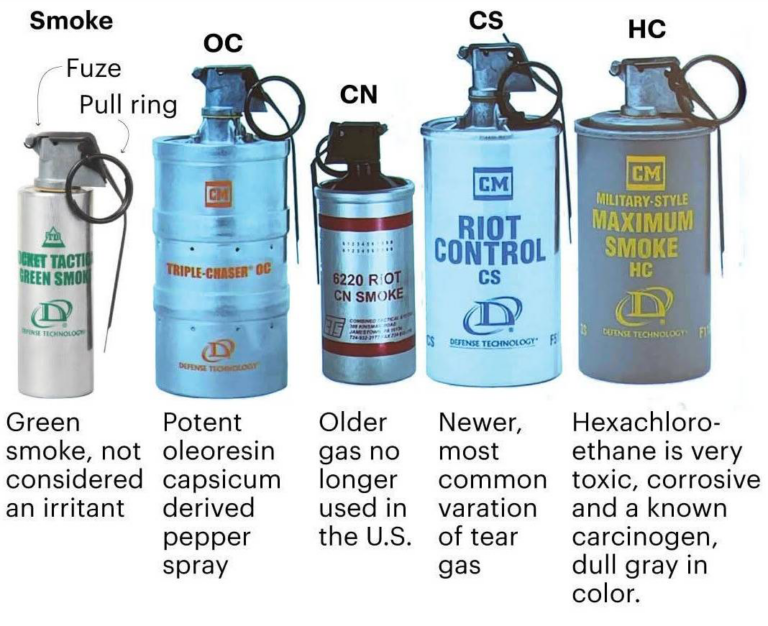
What they are
Chemical irritants are deployed using handheld sprays, grenades, or launched canisters. Common agents include CS gas (tear gas) and OC (oleoresin capsicum, often called pepper spray).
What they’re intended to do
These agents cause intense irritation to the eyes, skin, and respiratory system, temporarily incapacitating people by making it difficult to see, breathe, or remain in place.
What people experience
Burning eyes and skin
Coughing, choking, and chest tightness
Disorientation and panic
Nausea or vomiting
Documented risks
Asthma attacks and respiratory distress
Chemical burns with prolonged exposure
Injuries from canisters striking the body
Heightened risk in enclosed or crowded spaces
Canisters shown in the graphic may vary by size, color, and labeling depending on manufacturer and agency.
Impact Munitions (Rubber Bullets, Foam Rounds, Bean Bag Rounds)
What they are
Impact munitions are fired from launchers or shotguns and are designed to strike the body with blunt force rather than penetrate.
Despite the name, many are made of hard rubber, plastic, or metal-cored materials.
What they’re intended to do
They are meant to cause pain and deter movement or participation without using live ammunition.
What people experience
Severe bruising and welts
Lacerations or broken skin
Loss of balance or falls
Documented risks
Broken bones
Eye injuries and vision loss
Internal bleeding or organ damage
Permanent disability or death in rare cases
Medical organizations have documented serious injuries when these munitions are fired at close range or at the head, neck, or torso.
Long-Range Acoustic Devices (LRAD)
What they are
Long-Range Acoustic Devices emit highly focused, high-decibel sound waves. They are mounted on vehicles or tripods and can be directed toward crowds.
What they’re intended to do
LRADs are used to issue commands over distance or to disperse crowds by creating overwhelming noise.
What people experience
Extreme discomfort or pain
Ringing in the ears
Disorientation or nausea
Documented risks
Temporary or permanent hearing loss
Balance disturbances
Neurological effects reported in some cases
Because sound intensity decreases unevenly across space, people closest to the device may experience far greater harm than others nearby.
You can learn more about how LRAD works here.
Additional Resources
Los Angeles Protests: Weapons of Control – What U.S. police are using to corral, subdue and disperse demonstrators
https://www.reuters.com/graphics/USA-MIGRATION/PROTEST-LOSANGELES-WEAPONS/zdpxalxkyvx/
Lethal in Disguise 2: How Crowd-Control Weapons Impact Health and Human Rights
https://policehumanrightsresources.org/lethal-in-disguise-2-how-crowd-control-weapons-impact-health-and-human-rights
Identifying ‘Less-Lethal’ Weapons Used By DHS Agents in US Immigration Raids and Protests
https://www.bellingcat.com/resources/2026/01/27/less-lethal-weapons-guide/